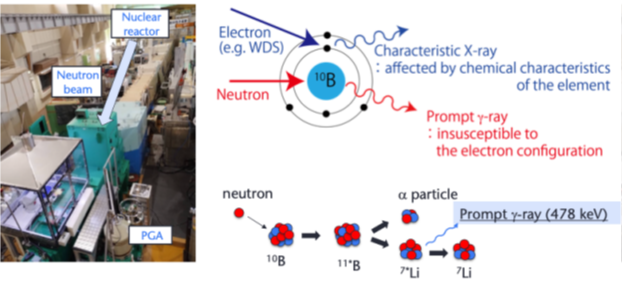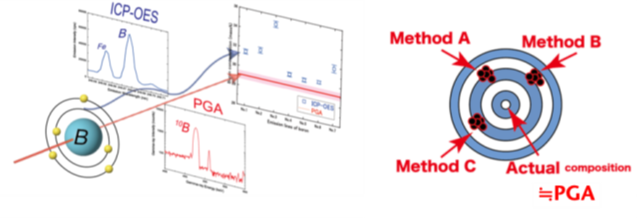

Light elements such as hydrogen and boron are difficult to measure accurately with conventional analytical methods. As a result, the uncertainty in their measured concentrations is often large. For example, analyzing the same sample with Instrument A, B, and C can yield different results. If this situation continues, research institutions around the world will only have “relative values,” and we won’t know the common, comparable quantitative values that serve as a global standard.
Our research addresses this challenge by using neutrons emitted from nuclear reactors to build a foundation for highly accurate quantitative analysis. Conventional methods rely on reactions involving electrons in the material, which tend to introduce greater uncertainty. In contrast, neutron-based methods use reactions involving the atomic nucleus, making the measurements fundamentally more accurate.
This technique is called Prompt Gamma-ray Analysis. We are leveraging Japan’s world-class analytical technology to apply this method to materials research. Our goal is to develop standard reference materials and new analytical techniques that improve the reliability of measurement data worldwide.