
Department Overview
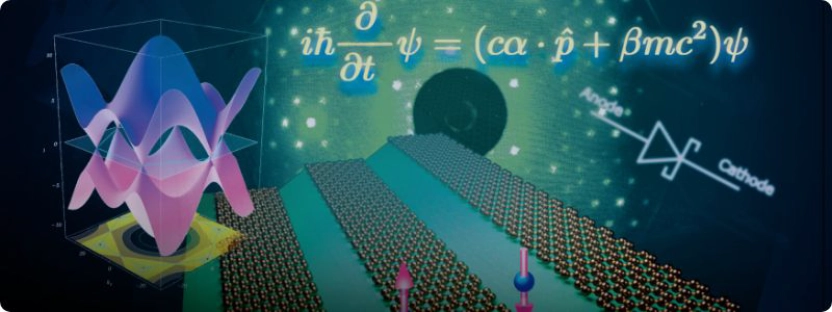
A quantum is the minimum amount of any physical entity described by discrete values. It is a basic and universal concept that dominates the behavior of the fundamental constituents of matter – atoms, electrons, atomic nuclei and elementary particles. Quantum theory is a relatively new area of study for which Planck formed a hypothesis in the early 20th century, and which Einstein, Bohr, Heisenberg and other scientists have further pursued. The Department of Applied Quantum Physics and Nuclear Engineering in the Graduate School of Engineering addresses global energy and environmental problems from the fundamental and universal quantum viewpoint to find engineering solutions.
Since global energy and environmental problems occur as the result of complex interactions of various phenomena, solutions require the integration of many areas of expertise and the exploration of new areas of science and technology. The philosophy of this department is to challenge these problems from broad and long-term perspectives, and to cultivate engineers and researchers who aspire to explore new areas of science and technology. Based on this philosophy, we provide education and research opportunities in nuclear energy engineering, quantum beam engineering, environmental engineering and advanced physics. By studying various phenomena related to energy and the environment in a microscopic manner using the basis of quantum theory, and by conducting basic research and providing education to pursue theories that connect microscopic phenomena and macroscopic characteristics from both micro- and macroscopic approaches, we produce students who can provide broad-ranging and multidimensional thinking, flexibility and a global mindset.
Educational Aims
Since global energy and environmental problems occur as the result of complex interactions of various phenomena, solutions require the integration of many areas of expertise and the exploration of new areas of science and technology. The philosophy of the Department of Applied Quantum Physics and Nuclear Engineering in the Graduate School of Engineering is to address these problems using broad-based and long-term perspectives, and to cultivate engineers and researchers who aspire to explore new areas of science and technology. By studying various phenomena related to energy and the environment in a microscopic manner, using the basis of quantum theory, and by conducting basic research and providing education to pursue theories that connect microscopic phenomena and macroscopic characteristics from both micro- and macroscopic approaches, we produce students who can provide broad-ranging and multidimensional thinking, flexibility and a global mindset. Education is provided with a particular emphasis on the study of nuclear energy utilization and other types of new energy; the principles of generation, measurement and use of quantum beams; advanced materials for energy use and the conservation of the environment; and physical properties and formation mechanisms of various smart materials and complex systems.
For details regarding post-graduation pathways, employment destinations, and laboratory information, please refer to the page below.
Admission Policy
We seek a student who takes pride in having studied the core secondary school subjects of mathematics, physics and chemistry diligently, in pursuit of truth and the application of cutting-edge physics to engineering. They are equally passionate about mastering cultural subjects such as Japanese, foreign languages and social sciences, and place great importance on ‘the depth of human understanding’.
Education and Research Fields
Department of Applied Quantum Physics and Nuclear Engineering
Applied Nuclear Physics
Nuclear Energy Systems
Quantum Sciences of Materials
Applied Physics
Educational Philosophy and Aims
-
1. Educational Objectives of Kyushu University
The Kyushu University Educational Charter abides by the following principles: “The Principle of Humanity”, “The Principle of Social Responsibility”, “The Principle of Global Citizenship”, and “The Principle of the Advancement of Knowledge”. Through the education of individuals capable of leadership in a diverse range of fields in Japan and willing to assume an active role in the world, especially in Asia, Kyushu University aims at contributing to progress throughout the world.
-
2. Educational Objectives of the Graduate School of Engineering
Given Kyushu University’s position as a foremost graduate university, the central aim the Graduate School of Engineering is to be a leader in the advancement of industrial technology in Japan. We endeavor to provide an education framework which nurtures talented individuals who possess outstanding professional and comprehensive abilities to assist the continuous development of human beings. To achieve this goal, in adherence to the Kyushu University Educational Charter, the Graduate School emphasizes research and problem-solving skills, and develops creative-thinking ability.
-
3. Objectives as of Mid-Year
Summary
(1) Educational Aims
We address morality, responsibility to society, and internationalism, and we develop creative-thinking skills while stressing professionalism combined with comprehensive knowledge
After program completion we aim to improve our students’ rate of admission to the last half of doctoral programs, their pass rate for national exams, and their employment rate in the types of industries, corporations, and institutions which fully display the skills acquired through their studies.
We employ an evaluation system to assess the achievements of students of the Graduate School, and we allow for assessment from outside sources. Additionally we employ evaluation of our educational processes by a third party, and conduct presentations of research results at international conferences.(2) Curricula Objectives
Our curricula are designed to provide the skills necessary to become researchers and top-level professionals.
Our curricula objectives and methodology are made transparent for the purpose of constructive feedback. We adjust our programs and lecture content to reflect the opinions and suggestions of our students.
Our educational methods are analyzed based on their contributions to society, the results of projects, and the quality of theses and research activities.
We establish achievement goals and maintain a record of appraisal for each subject and publish the information for students’ perusal.
We clearly document and publish our processes and evaluation systems in regard to examinations, and masters’ and doctoral theses.(3) Support Structure
We establish a framework to improve program majors, curricula, and our overall system of education. We employ experienced teachers who are assigned to their respective areas of expertise. We also incorporate laboratory work and a full educational support system which includes the use of Teachers’ Assistants (TA’s).
We maintain an internship system to provide practical experience.
We maintain a supportive educational environment including students’ offices, laboratories, resource books and materials, and information media which allows for the adaptability of our campus to future trends.
We adhere to an inspection and evaluation system of operations and academic staff by third parties. The results of these evaluations and related recommendations are used to improve the overall quality of our programs and educational processes.(4) Support of Graduate Students
We maintain a system which allows for daily consultation and advisement.
We have established a counseling room, placement officers, as well as a comprehensive job information system.
We provide financial assistance to graduate students.
We provide support services for international students, and continuing education students.(5) Additional Objectives
We endeavor to work closely with local communities and initiate projects to provide continuing education programs to working individuals.
We have established a system of cooperation between government, industry, and academia to provide internship training opportunities for graduate students.
We promote our International Special Course on Environment Systems Engineering, and foster cultural academic exchange with universities in other countries. We have also developed an effective system of remote international education.
We encourage international exchange in every area of expertise, and support international research meetings.