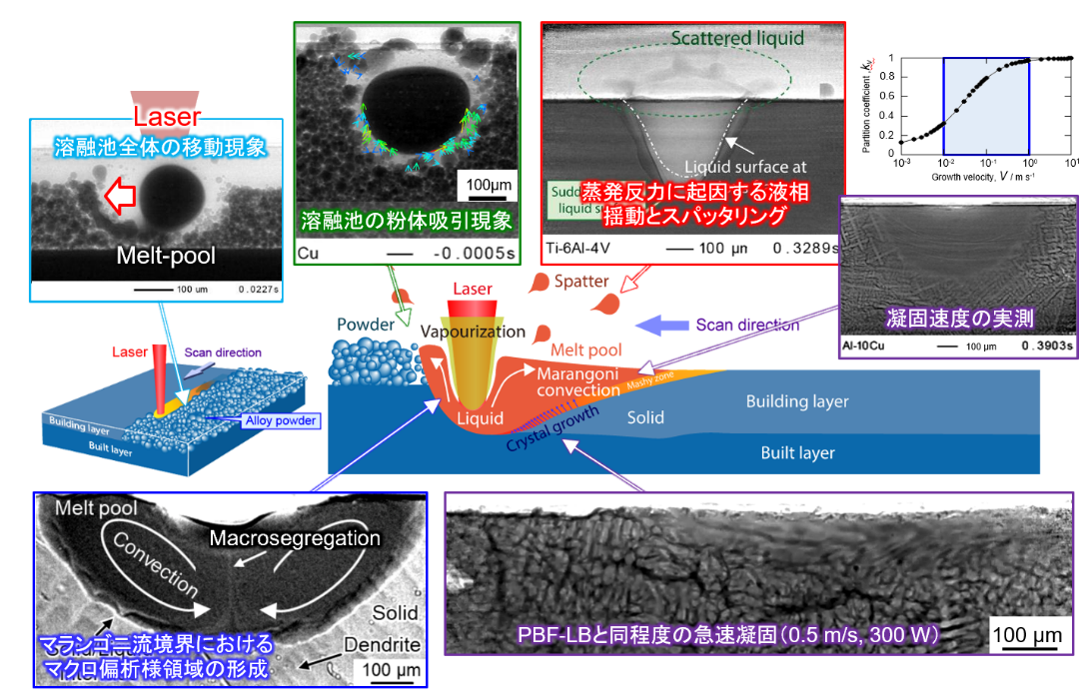

Metal Additive Manufacturing (AM) has attracted considerable attention as a next-generation manufacturing technology that enables the fabrication of complex-shaped components unconstrained by conventional machining tools, while also enhancing the intrinsic performance of metallic materials themselves. However, under the extreme process conditions of rapid melting and rapid solidification, phenomena such as unconventional segregation behavior, defect formation, and the generation of residual stresses tend to occur, making their mitigation a critical challenge. At the same time, this unique solidification environment also offers new opportunities for improving material performance, including the accumulation of crystallographic misorientations around fine columnar grains and the formation of metastable phases that cannot be achieved by conventional processes. The mechanisms underlying these phenomena remain insufficiently understood and must be fundamentally interpreted as physical processes inherent to solidification itself.
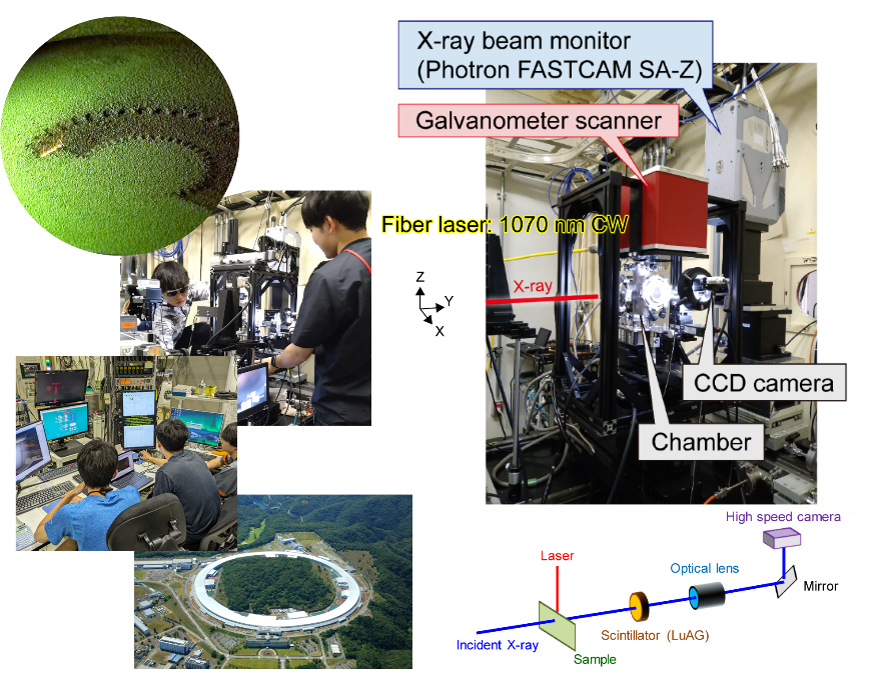
In this study, we employ high–time-resolution in-situ observations at frame rates of up to 20,000 frames per second using the large-scale synchrotron radiation facility SPring-8, enabling direct visualization of the dynamic processes occurring as metals melt, flow, and solidify within the liquid phase. This approach allows us to experimentally capture phenomena that previously had to be inferred indirectly. Furthermore, by linking these observations with theoretical frameworks and constructing appropriate models, we systematically organize how variations in alloy composition and steep thermal gradients influence microstructure formation. Through this approach, we aim to establish new scientific principles that can be extended to defect suppression, microstructure control, and the active utilization of metastable phases unique to metal AM.