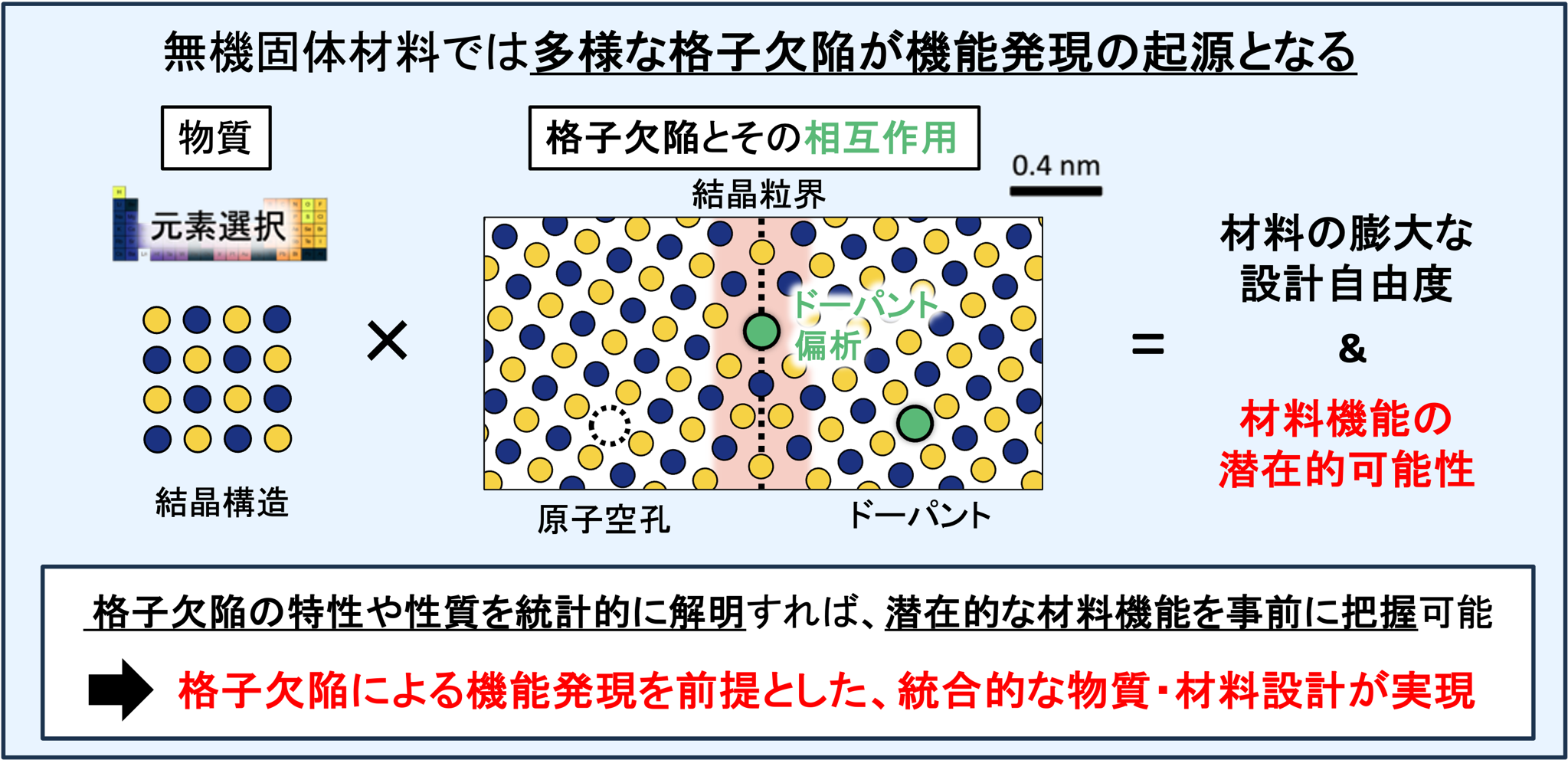

Nanoscale lattice defects are inevitably present in inorganic solid materials (Fig. 1). These defects appear in a wide variety of forms and are deeply involved in the emergence of diverse material functionalities. For example, the addition of impurity elements can induce luminescence, while the formation of atomic vacancies can give rise to ionic conductivity. In regions known as grain boundaries, it is also well established that electronic conductivity and thermal conductivity can change by several orders of magnitude. In this way, controlling material properties by leveraging lattice defects lies at the heart of inorganic materials science and has long driven the development of many engineering devices. But how far could material performance be enhanced if we could selectively design and control lattice defects—including their atomic structures—that are responsible for such functions? Answering this question is not straightforward. Although electron microscopy enables atomic-scale observation of lattice-defect structures, limitations in instrumentation and specialized expertise make it impractical to comprehensively analyze the vast number of possible defect configurations. Meanwhile, remarkable advances in computational and data science in recent years are making it increasingly feasible to tackle this challenge head-on. First-principles calculations based on quantum mechanics can reveal the structures and functions of lattice defects with high accuracy. Moreover, machine-learning models trained on first-principles data are now being developed, enabling defect calculations to be accelerated and scaled up by orders of magnitude. In this research, we aim to fully exploit these cutting-edge techniques to quantitatively link diverse defect configurations to material functionalities and to establish a foundational methodology for predicting macroscopic material properties from microscopic information. Through this effort, we will contribute to the development of functional materials that help address energy challenges, including thermoelectric materials and fuel cells.