
Since the so-called “VR first year” in 2016, the widespread adoption of Head-Mounted Displays (HMDs) has rapidly expanded VR research. VR is now actively explored in education, healthcare, sports, and professional training as a powerful tool for human augmentation. However, much of today’s research relies on commercially available HMDs, and fewer studies seek to fundamentally redefine what virtual reality is and what technologies will shape the future of human perception.
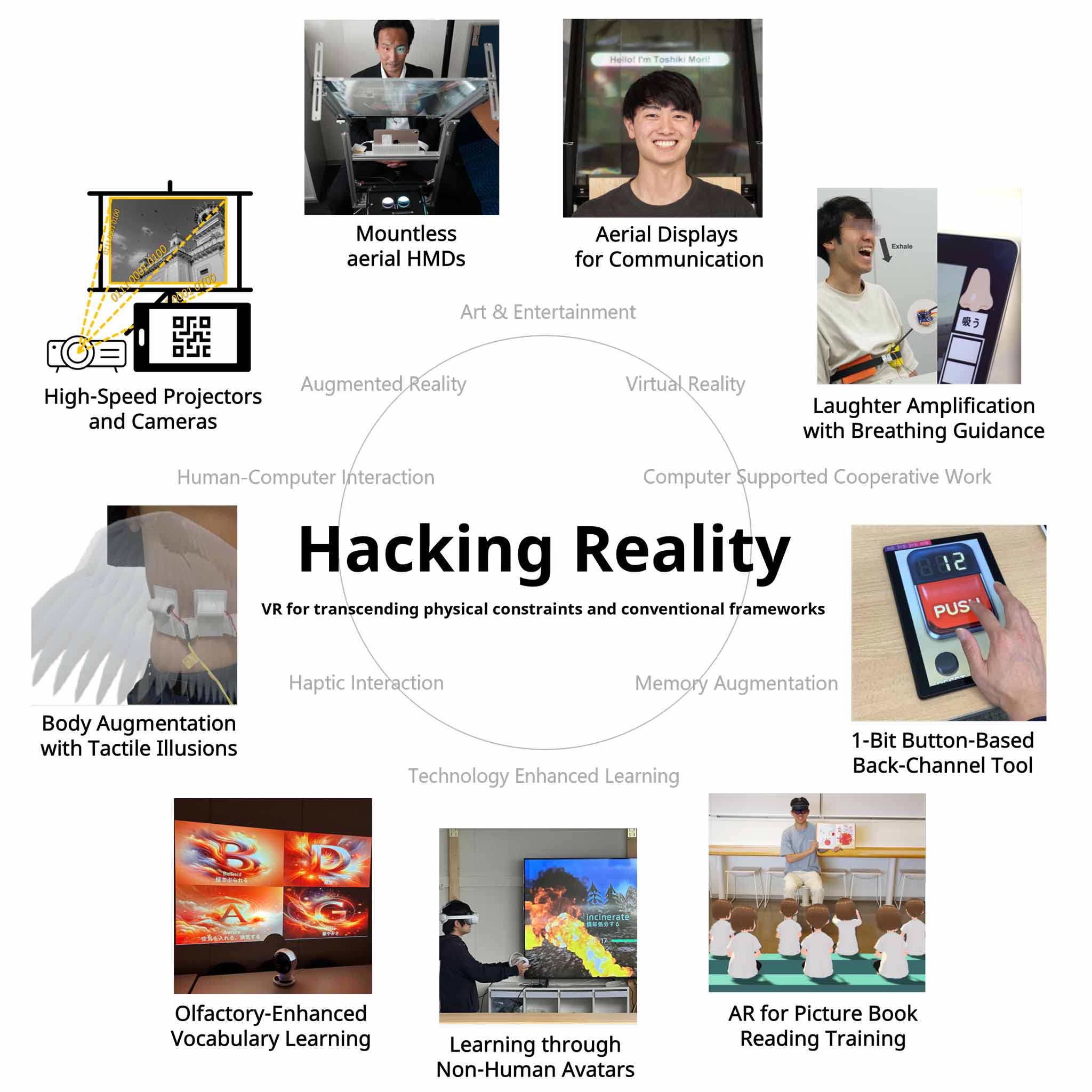
Our laboratory approaches this challenge from the perspective of Reality Perception augmentation. We view VR not merely as a technology for presenting virtual environments, but as a medium for extracting essential properties of the real world and reconstructing them beyond spatial and temporal constraints. By connecting these essential elements with human perception, embodiment, and emotion, we aim to create new forms of reality. Our research is organized around three core themes: Visual Liberation, Emotional Liberation, and Embodied Liberation. These include the development of aerial image displays, investigations into emotion–neural interactions, and skill and knowledge acquisition through virtual body augmentation. Free from conventional assumptions, we pursue “Hacking Reality”—the redesign of reality itself.
We believe that strong conviction is essential in creating things, experiences, and people. Even if others do not immediately understand an idea, what matters is the determination to pursue what you truly believe in. We welcome those who are eager to push their passions to the limit and create new forms of reality with us.

Member
The Main Research Topics
Virtual Reality
Human-Computer Interaction
Augmented Reality
Technology Enhanced Learning