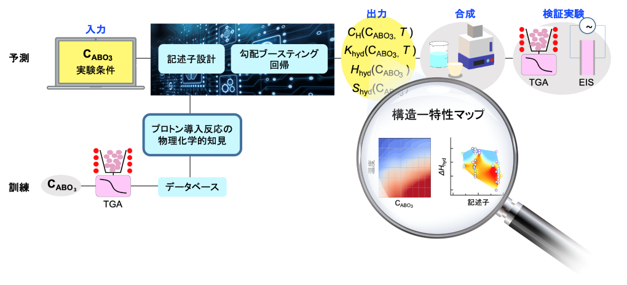

Our research group, in collaboration with researchers in Japan, developed an artificial intelligence (AI) model to search for proton-conducting oxides, which are required for solid oxide fuel cells (SOFCs) operating at around 400°C, and successfully discovered a new proton-conducting electrolyte with only a single experiment.
Achieving proton conductivity in metal oxides requires a complex process: substituting part of the constituent elements with dopants to create oxygen vacancies and thereby induce a proton incorporation reaction.
However, it is not self-evident which combinations of elements will yield proton conduction in previously unknown materials.
Because the possible combinations of constituent elements are virtually limitless, the development of new proton-conducting electrolytes has traditionally relied on researchers’ experience and intuition. In this study, we focused on perovskite-type oxides and trained the AI model using characteristic compositional features of previously identified proton-conducting materials, together with physicochemical knowledge related to proton incorporation (Fig. 1).
Based on the predicted temperature dependence of proton concentration, we identified the previously unknown Sc-doped SrSnO₃ as a proton-conducting oxide through just one experiment.
This achievement demonstrates the power of organically integrating experiments with data science. The proposed model is expected to greatly accelerate the development of proton-conducting oxides and intermediate-temperature SOFCs.