
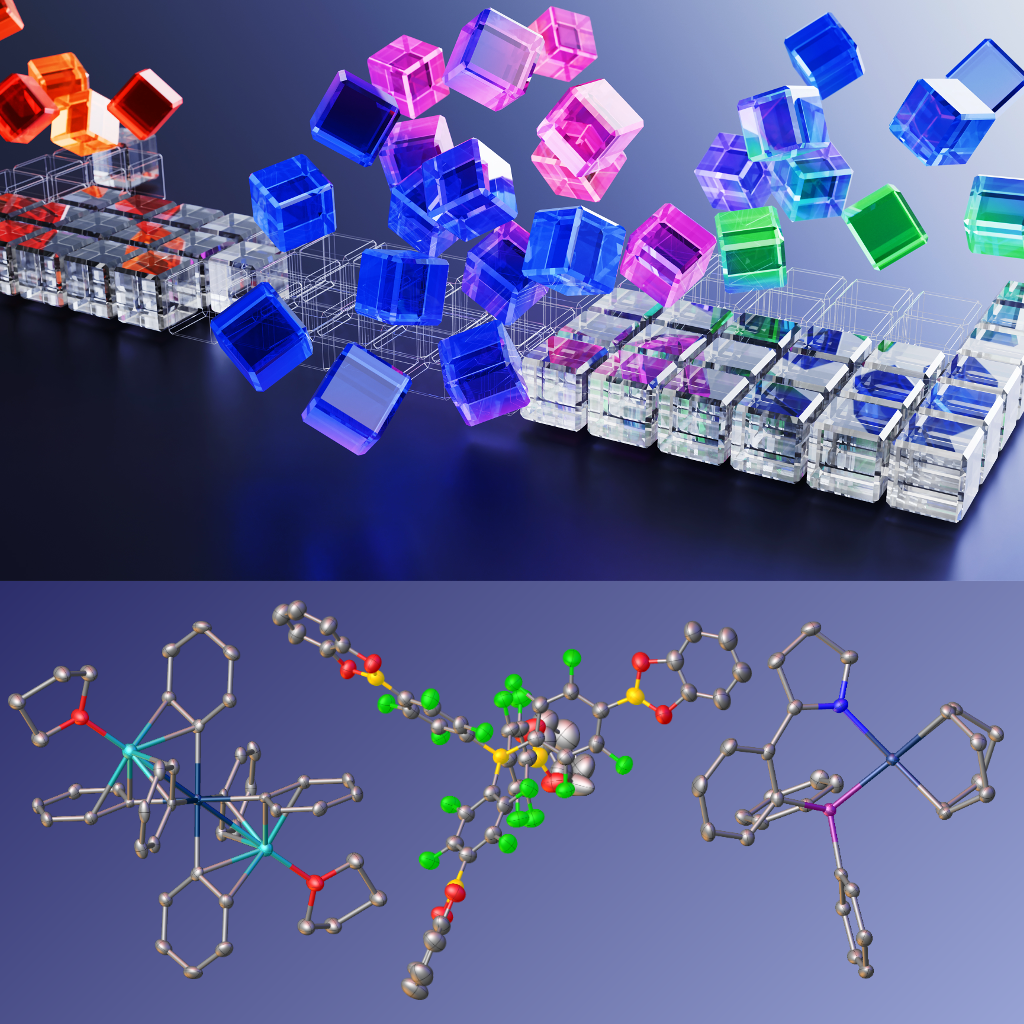
Synthetic organic chemistry, which produces new molecules by combining simple molecules, is a fundamental field of materials science. In our laboratory, we are engaged in the design and synthesis of novel functional molecules and the development of novel catalytic reactions to connect molecules. We are developing new catalysts that utilize various transition metal elements as active centers for bond-forming reactions that efficiently synthesize organic molecules. We are also working on the development of catalysts for bond-cleavage reactions to solve environmental problems caused by plastic wastes.
We design and synthesize new molecular materials, and explore how their properties relate to their molecular structures. This molecular engineering enables us to develop the next generation of functional π-materials based on artificial molecular evolutions of natural tetrapyrrolic pigments, known as porphyrins. Through our original synthetic methodologies, namely, “N-confusion” approach, a various classes of functional porphyrin analogues have been developed toward the specific applications as, e.g., highly active and robust catalysts, high-performance opt-materials, agents for bio-sensing and photodynamic therapy (PDT) etc. Likewise, we are pursuing in the another research area on artificial functional phthalocyanine-based materials and BODIPY dyes as tools for material sciences.
Member
The Main Research Topics
Development of Transition Metal Catalysts and Their Application to Organic Synthesis
Development of Bond Cleavage Reactions toward Chemical Recycling of Plastic Wastes
Evolution of Novel Functional Phthalocyanine Analogues
Creation of Novel BODIPY and Aza-BODIPY-based Optical Materials